Regnum Sinense

京城日報

Keijō Nippō (Seoul), 14 October 1924

Newspaper · Catalogue · Warlord era 北洋軍閥時期 · The Second Zhili–Fengtian War
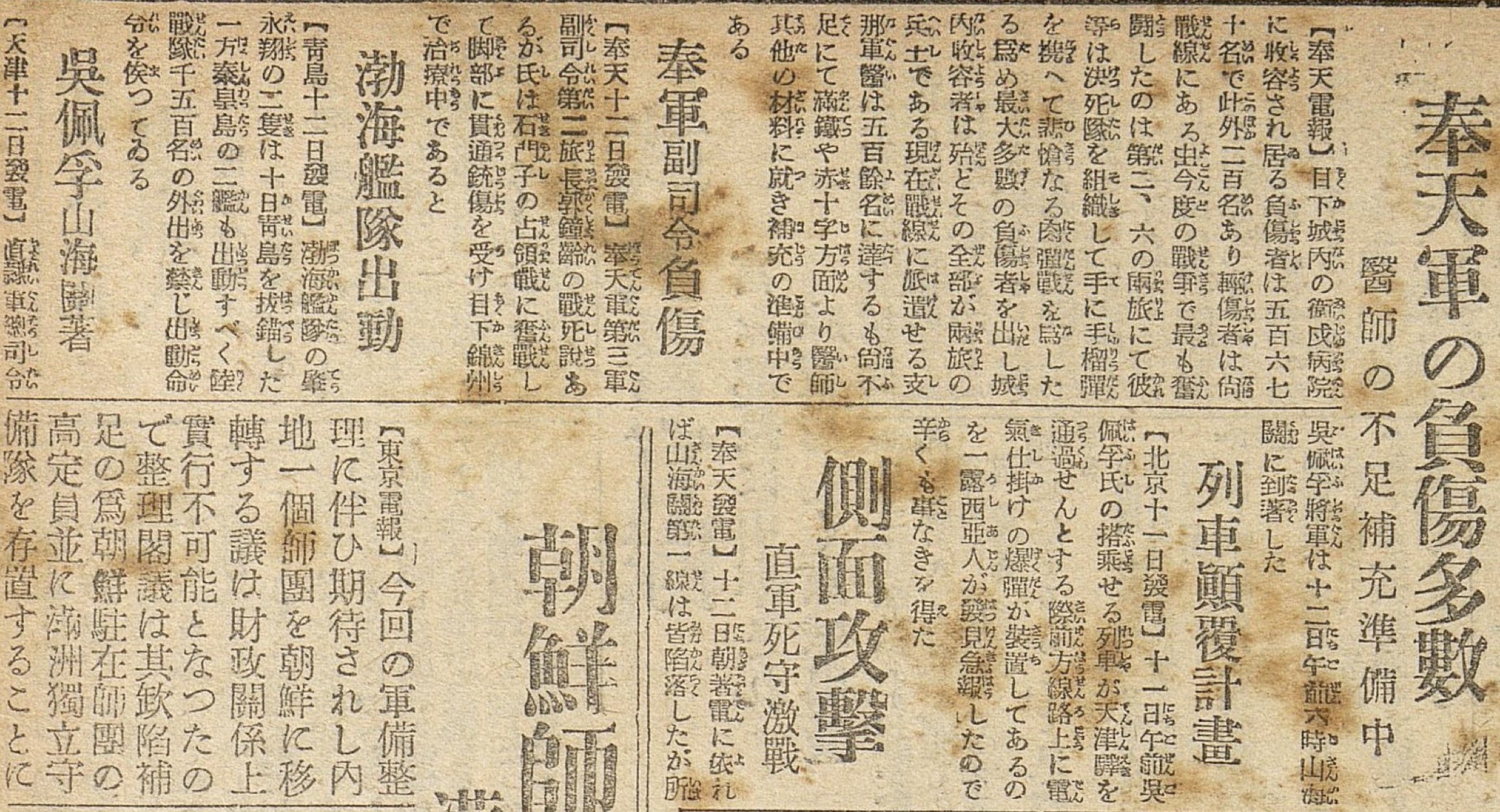

京城日報 14 October 1924
Source: Wikimedia Commons: CNTS-00118522579 京城日報 1924-10-14. Click the clipping to enlarge it; click again, or press Esc, to close.

Introduction

Six items from the war page of the Keijō Nippō, the Japanese-language daily of Seoul, of 14 October 1924: telegrams of 11–12 October from the Shanhai Pass front of the Second Zhili–Fengtian War, on the Fengtian wounded, the wounding of Guo Songling, the Zhili fleet, Wu Peifu's arrival at the front and a plot against his train.

The transcription keeps the paper's characters and its furigana, in the historical kana spelling of the time. Chinese names are given in the translation in their Japanese readings, as the paper's readers read them; each Persons and Places entry gives the pinyin.


Text and Translation

Text: Japanese source

Text: English Translation

Annotations

奉天軍の負傷多數

醫師の不足補充準備中

Many wounded in the Hōten army

Shortage of doctors; reinforcements in preparation

目下もくか城內じゃうないの衛戍病院ゑいじゅびゃうゐんに收容しうようされ居ゐる負傷者ふしゃうしゃは五百六七十名ごひゃくろくしちじふめいで此外このほか二百名にひゃくめいあり輕傷者けいしゃうしゃは尚なほ戰線せんせんにある由よし

【Hōten telegram】1The wounded now housed in the garrison hospital within the city walls2 number five hundred and sixty or seventy3, and there are two hundred more besides; the lightly wounded are reported4 to be still at the front.

今度こんどの戰爭せんさうで最もっとも奮鬪ふんとうしたのは第二だいに、六ろくの兩りゃう旅りょにて彼等かれらは決死隊けっしたいを組織そしきして手てに手榴彈しゅりうだんを携たづさへて悲愴ひさうなる肉彈戰にくだんせんを爲なしたる爲ため最大多數さいだいたすうの負傷者ふしゃうしゃを出いだし城內じゃうない收容者しうようしゃは殆ほとんどその全部ぜんぶが兩旅りゃうりょの兵士へいしである

In the present war the hardest fighting fell to the Second and Sixth Brigades: they formed death squads and, grenades in hand, fought a grim battle of human bullets5, and so produced the greatest number of wounded; almost all of those housed in the city are soldiers of these two brigades.

現在げんざい戰線せんせんに派遣はけんせる支那しな軍醫ぐんいは五百餘名ごひゃくよめいに達たっするも尚なほ不足ふそくにて滿鐵まんてつや赤十字せきじふじ方面はうめんより醫師いし其他そのたの材料ざいれうに就つき補充ほじゅうの準備中じゅんびちうである

The Chinese army doctors now sent to the front number more than five hundred but are still too few, and preparations are being made to bring in doctors and other supplies from the South Manchuria Railway and the Red Cross.

奉軍副司令負傷

Hōten deputy commander wounded

奉天軍ほうてんぐん第三軍だいさんぐん副司令ふくしれい第二だいに旅長りょちゃう郭鐘齡くわくしょうれいの戰死說せんしせつあるが氏しは石門子せきもんしの占領戰せんりゃうせんに奮戰ふんせんして脚部きゃくぶに貫通銃傷くわんつうじうしゃうを受うけ目下もくか錦州きんしうで治療中ちれうちうであると

【Hōten, the 12th】6There is a report that Kaku Shōrei7, deputy commander of the Third Army of the Hōten army and commander of its Second Brigade, has been killed in action; but he fought hard in the battle for Sekimonshi8, took a bullet through the leg, and is now under treatment at Kinshū.

渤海艦隊出動

The Bokkai Fleet puts out

渤海艦隊ぼっかいかんたいの肇永翔てうえいしゃうの二隻にせきは十日とをか青島ちんたうを拔錨ばつべうした一方いっぱう秦皇島しんくわうたうの二艦にかんも出動しゅつどうすべく陸戰隊りくせんたい千五百名せんごひゃくめいの外出ぐわいしゅつを禁きんじ出動命令しゅつどうめいれいを俟まつてゐる

【Chintao, the 12th】Two ships of the Bokkai Fleet, the Chōwa and the Eishō9, weighed anchor at Chintao on the 10th; the two ships at Shinkōtō are also to put out, and with shore leave stopped for their fifteen hundred marines they await the order to sail.

吳佩孚山海關著

Go Haifu arrives at Sankaikan

直隸軍ちょくれいぐん總司令そうしれい吳佩孚ごはいふ將軍しゃうぐんは十二日じふににち午前六時ごぜんろくじ山海關さんかいくわんに到着たうちゃくした

【Tenshin, the 12th】General Go Haifu, commander-in-chief of the Chokurei army, arrived at Sankaikan at six in the morning of the 12th.

列車顛覆計畫

Plot to derail a train

十一日じふいちにち午前ごぜん吳佩孚ごはいふ氏しの搭乘たふじょうせる列車れっしゃが天津てんしん驛えきを通過つうくわせんとする際さい前方ぜんぱう線路上せんろじゃうに電氣仕掛でんきじかけの爆彈ばくだんが裝置さうちしてあるのを一露西亞人いちろしあじんが發見はっけん急報きふはうしたので辛からくも事ことなきを得えた

【Pekin, the 11th】On the morning of the 11th, as the train carrying Go Haifu was about to pass through Tenshin Station10, a Russian found an electrically fired bomb planted on the line ahead and gave the alarm, and so a disaster was narrowly avoided.

側面攻擊

直軍死守激戰

Flank attack

The Chokurei army fights hard to hold on

十二日じふににち朝あさ著電ちゃくでんに依よれば山海關さんかいくわん第一線だいいっせんは皆みな陷落かんらくしたが所

【Hōten telegram】By a telegram received on the morning of the 12th, the whole first line at Sankaikan has fallen.

Click each triangle to expand/collapse note
Top of page | Top of text

Terms

garrison hospital / 衛戍病院n. a military hospital of a garrison town.
brigade / 旅n. the army unit of the period between regiment and division.
death squad / 決死隊n. a party of volunteers for an assault from which return is not expected.
army doctor / 軍醫n. a medical officer of the army.
the South Manchuria Railway / 滿鐵n. the South Manchuria Railway Company (南滿洲鐵道), the Japanese railway concern in Manchuria.
the Red Cross / 赤十字n. the Red Cross society.
deputy commander / 副司令n. the second in command of an army.
the Hōten army / 奉天軍n. the forces of the Fengtian clique; also written 奉軍.
brigade commander / 旅長n. the officer commanding a brigade.
the Bokkai Fleet / 渤海艦隊n. the naval squadron on the Zhili side in 1924, based at Qingdao and Qinhuangdao.
marines / 陸戰隊n. a navy's landing force.
commander-in-chief / 總司令n. the officer in supreme command.
the Chokurei army / 直隸軍n. the forces of the Zhili clique; also written 直軍.

Persons

Kaku Shōrei 郭松齡Guo Songling in pinyin, Kaku Shōrei in Japanese reading. General of the Fengtian army, deputy commander of its Third Army in 1924; the paper writes 郭鐘齡.
Go Haifu 吳佩孚Wu Peifu in pinyin, Go Haifu in Japanese reading. General of the Zhili clique, commander-in-chief of its forces in the war of 1924.

Places

Hōten 奉天Fengtian in pinyin, Hōten in Japanese reading; the Mukden of the Western press of the day. The seat of the Fengtian clique; modern Shenyang, Liaoning.
Sekimonshi 石門子Shimenzi in pinyin, Sekimonshi in Japanese reading: the Shimenzhai 石門寨 of the Chinese accounts, in the hills north-west of Shanhai Pass; modern Shimenzhai, Qinhuangdao, Hebei.
Kinshū 錦州Jinzhou in pinyin, Kinshū in Japanese reading; a city of western Fengtian province; modern Jinzhou, Liaoning.
Chintao 青島Qingdao in pinyin, Chintao in Japanese reading; the port on the Shandong coast; modern Qingdao.
Shinkōtō 秦皇島Qinhuangdao in pinyin, Shinkōtō in Japanese reading; the port on the Bohai coast west of Shanhai Pass; modern Qinhuangdao, Hebei.
Tenshin 天津Tianjin in pinyin, Tenshin in Japanese reading; the port city on the Hai River; modern Tianjin.
Sankaikan 山海關Shanhaiguan in pinyin, Sankaikan in Japanese reading; the Pass where the Great Wall meets the sea, on the road from Hebei into Manchuria; modern Shanhaiguan, Qinhuangdao, Hebei.
Pekin 北京Beijing in pinyin, Pekin in Japanese reading; the capital of the Republic in 1924; modern Beijing.

Notes

1 Hōten telegramThe datelines give the place and the day a telegram was sent; the days are of October 1924. Names are given in their Japanese readings, as the paper's readers read them; the pinyin is in the Persons and Places entries. 奉天 Hōten is Fengtian, the Mukden of the Western press of the day and the seat of the Fengtian clique.
2 within the city walls城內: inside the walled city, that is Hōten (Fengtian), from which the telegram was sent.
3 five hundred and sixty or seventy五百六七十名: five hundred and sixty-odd to seventy-odd.
4 reported由: the hearsay marker; the sentence reports what is said of the lightly wounded.
5 battle of human bullets肉彈戰: a close assault in which the men themselves are the projectiles, a phrase of the Japanese press since the Russo-Japanese War.
6 Hōten, the 12th奉天十二日發電: sent from Hōten (Fengtian) on the 12th.
7 Kaku Shōrei郭鐘齡: the paper's writing of 郭松齡, Kaku Shōrei (Guo Songling in pinyin).
8 Sekimonshi石門子 Sekimonshi: the Shimenzhai 石門寨 of the Chinese accounts, in the hills north-west of Shanhai Pass.
9 the Chōwa and the Eishō肇永翔: the cruisers Chōwa 肇和 and Eishō 永翔 (Zhaohe and Yongxiang in pinyin), their names run together.
10 Tenshin Station天津驛 Tenshin Station: 驛, here the railway station.